
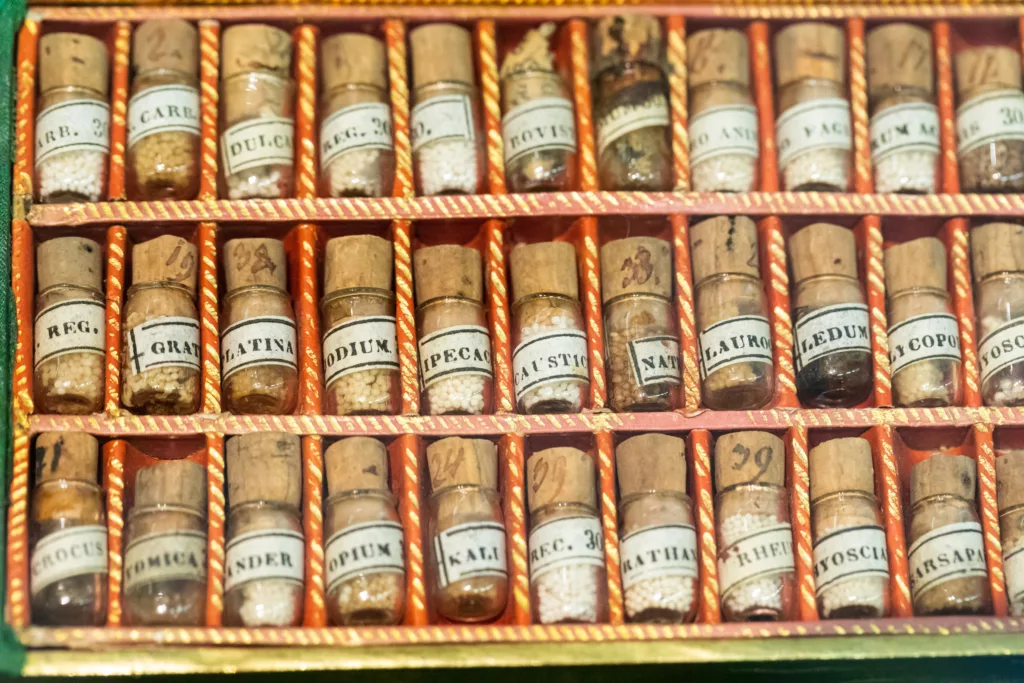
The short answer: Homeopathy has its own language. This glossary explains the most common homeopathic terms in plain words, from acute illness to vital force, so you can follow along with confidence if you’re new to homeopathy.
Homeopathy is a system of healing developed by Samuel Hahnemann, a physician and chemist, over 200 years ago. Today it’s considered a complementary and alternative approach.
In homeopathy, illness is understood as an inner state of imbalance that shows up through symptoms. With the right support, the body is understood to have its own capacity to return to balance. Homeopathic care uses remedies made from substances found in nature. Each remedy is chosen based on how closely it matches the person’s symptoms, and remedies are understood to act energetically rather than chemically, supporting the body’s own healing capacity. Homeopathy offers a different way of looking at the body, symptoms, and healing. Many of its terms aren’t used anywhere else, so they can feel unfamiliar at first. Use this glossary as a reference as you learn, or bring your questions to your homeopath.Jump to a letter: A · C · D · I · L · M · N · P · R · S · T · V
Homeopathic Terms A to Z
A
Acute illness: An illness that comes on quickly, lasts a short time, and usually has a clear trigger, such as exposure or an injury. The flu or an earache are examples of acute illnesses. Aggravation: A temporary worsening of symptoms after taking a remedy, sometimes called a healing crisis. In homeopathy, an aggravation can be a sign that the remedy is a good fit, but it isn’t required and isn’t the only sign. If you think you’re having an aggravation, talk with your homeopath. Learn more in What to Expect After Taking a Homeopathic Remedy. Antidote: Something that neutralizes or counters the effect of a homeopathic remedy. Common examples include coffee, strong mints or smells (such as peppermint or camphor), and extreme stress. Not all homeopaths treat antidotes the same way, since everyone responds differently, but people who are especially sensitive to remedies or their surroundings may be more likely to antidote a remedy. If you’re concerned about this, ask your homeopath.C
Chief complaint: The main issue that brings you to homeopathic care. Chronic condition: A long-standing illness with symptoms that come on slowly over time and tend to persist or worsen. Asthma and arthritis are examples of chronic conditions. Concomitant: A symptom that happens at the same time as the chief complaint. For example, if your eyes water every time you cough, watery eyes are a concomitant of the cough.D
Dilution: See “potentization.”I
Isopathy: The use of a homeopathically prepared form of the very substance linked to an illness. Isopathy and homeopathy differ in how remedies are chosen, not in the remedies themselves. An isopathic remedy is chosen because it’s identical to the cause, while a homeopathic remedy is chosen because it’s similar to the person’s symptoms. For example, a remedy made from ragweed pollen given for ragweed allergy symptoms would be isopathy. Only take an isopathic remedy under the care of a qualified homeopath. See also “tautopathy” and “law of similars.”L
Law of similars: A core principle of homeopathy, often summed up as “like cures like.” A substance that causes certain symptoms in a healthy person is understood to support healing of similar symptoms in someone who is ill, when given in potentized (homeopathically prepared) form. Location: The part of the body where a symptom is felt, such as the head, ear, stomach, leg, or ankle. It can also be a type of tissue, such as a joint, bone, or muscle.M
Materia medica: A reference book of homeopathic remedies and their symptoms. The information comes from provings, clinical experience, and toxicology reports. Two popular materia medicas for home users are The Complete Homeopathy Handbook by Miranda Castro and Desktop Guide to Keynotes and Confirmatory Symptoms by Roger Morrison. Miasm: In homeopathy, an underlying energetic pattern of susceptibility to illness that shows up as symptoms over time. Miasms may be inherited or acquired. The three primary miasms are psora, sycosis, and syphilis, and others include tubercular, malarial, typhoid, and cancer miasms. To learn more, read Miasms and Mythology by Luke Norland. Modality: What makes a person, or a particular symptom, feel better or worse. Modalities include time of day, temperature, weather, motion, position, touch or pressure, eating or drinking, menstruation, perspiration, and emotions.Learning the language of homeopathy? I share more guides like this in Homeopathy Undiluted, my newsletter. It’s hope and healing in your inbox: straight talk about homeopathy and whole-person healing.
N
Nosode: A homeopathic remedy made from diseased tissue, a discharge, or another product of illness. In homeopathy, nosodes are often used in relation to miasms. Common nosodes include Carcinosin, Medorrhinum, Syphilinum, and Tuberculinum. Only take a nosode under the care of a qualified homeopath. See also “miasm.”
P
Potency: The strength of a homeopathic remedy, shown as a number and letter after the remedy name, such as 12X, 30C, or 1M. Potency comes from potentization (dilution and succussion) during preparation. In homeopathy, the more a substance is potentized, the stronger it’s understood to be. Learn more in X, C, M, and LM: Understanding Homeopathic Potencies. See also “potentization.”
Potentization: The series of dilutions and succussions used to prepare a homeopathic remedy. Potentization creates a remedy’s potency, and in homeopathy it’s what makes a remedy both powerful and gentle. See also “potency” and “succussion.”
Proving: A study of a remedy to learn which symptoms it can produce. Healthy volunteers take the remedy and record every symptom they notice. At the end, the records are compared to find the physical, mental, and emotional symptoms the provers shared. Under the law of similars, those are the symptoms the remedy is understood to support. Learn more in How We Know the Symptoms of Remedies.
R
Remedy: A homeopathically prepared substance chosen to match a person’s symptoms and support the body’s own healing.
Repertory: An index of symptoms, organized by body area and symptom (for example, nose, congestion), that homeopaths use to find a remedy. The most famous is Kent’s Repertory by J.T. Kent. Homeopaths also use repertory software, such as Complete Dynamics, RadarOpus, and Synergy.
S
Sarcode: A homeopathic remedy made from healthy tissue. Sarcodes are part of a practice called organotherapy, and in homeopathy they’re understood to support the normal function of the matching tissue or organ. Only take a sarcode under the care of a qualified homeopath.
Sensation: How a symptom feels to you. Examples include throbbing, burning, aching, stinging, pressing, sore, bruised, heavy, stiff, or wandering.
Simillimum: The homeopathic remedy most similar to the totality of a person’s symptoms.
Source: The substance a remedy is made from. Substances that dissolve easily in alcohol and water are first made into a mother tincture, which is then potentized. Substances that don’t dissolve, such as metals, are first triturated, or ground with lactose or sucrose to make the particles smaller. Then potentization can begin. Learn more in How Homeopathic Remedies Are Made. See also “potentization.”
Succussion: The shaking or agitating of a remedy in liquid. When taking a liquid remedy, you may be asked to succuss it by tapping the bottle firmly against your palm, shaking it, or stirring it. Follow your homeopath’s directions. See also “potency” and “potentization.”
Suppression: In homeopathy, the driving of symptoms inward or deeper, which is understood to lead to deeper imbalance over time. In homeopathic philosophy, anything that turns a symptom down or off without addressing the underlying susceptibility can be suppressive, including homeopathic remedies used in a way that doesn’t follow homeopathic principles. Please don’t stop or change any medication or care from your doctor on your own. Learn more in What to Expect After Taking a Homeopathic Remedy.
T
Tautopathy: A form of isopathy that uses a homeopathically prepared form of a conventional drug to counter that drug’s unwanted effects. Only take a tautopathic remedy under the care of a qualified homeopath, and never change a medication from your doctor on your own.
Totality: All of the signs and symptoms a person experiences. Totality can also mean a single symptom and all of its features, including its origin, history, progression, location, sensation, and modalities. See also “sensation” and “modality.”
V
Vital force: In homeopathy, the energy that gives and sustains life in each person, understood as distinct from chemical or physical processes.
Have Questions About Homeopathy?
Learning these terms is a great first step, and you don’t have to figure everything out on your own. A classical homeopath can walk you through what homeopathy looks like for you or your child.
If you’d like to work with me, start with a free 15-minute intro call by Zoom or phone. We’ll talk about what you’re experiencing and whether homeopathy may be a good fit.
References
Yasgur, J. (2021). Yasgur’s Homeopathic Dictionary and Holistic Health Reference (6th ed.). Van Hoy Publishers.
About the author: Jill Page is a Certified Classical Homeopath (CCH) and Certified Homeopathic Practitioner (CHP) based in Lexington, Kentucky, offering consultations by Zoom. Learn more about Jill.
This article is for educational and informational purposes only and is not medical advice.